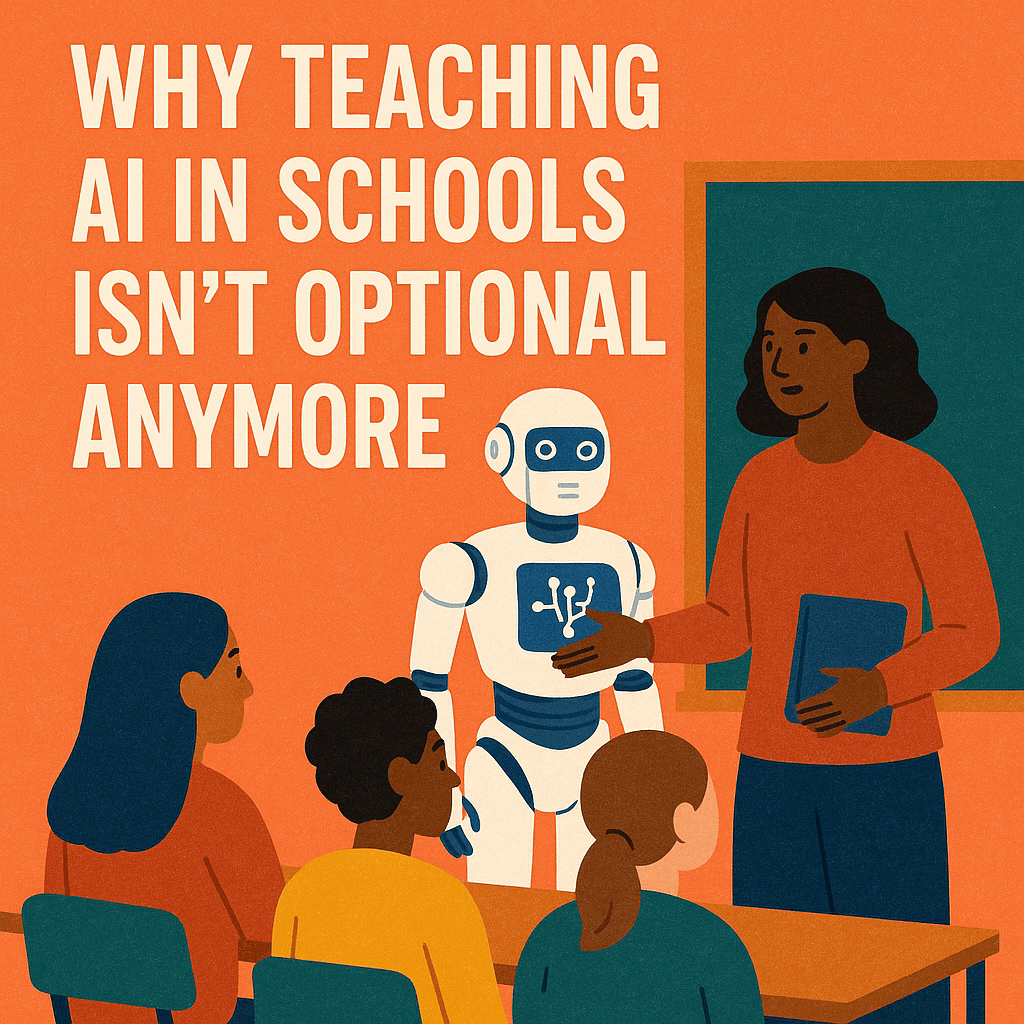
Why Teaching AI in Schools Isn’t Optional Anymore
 Lean Hyphen

Tomorrow’s students will work in unseen jobs, build unknown tools, and face unimaginable challenges.
There’s only one advantage that prepares them now: AI literacy.
We’re living through the biggest technological shift since the internet—and it’s not approaching; it’s already shaping our daily lives. Artificial Intelligence is everywhere: in the way we learn, search, shop, and connect. For today’s children, AI will become as fundamental as reading, writing, and arithmetic.
So the question for schools isn’t “Should we teach AI?”
It’s “How early can we begin?”
Because the answer is clear: the earlier, the better.
1. Preparing Students for Real-World Skills, Not Just Tests
Traditional education trains students to memorize and reproduce information.
But in a world where AI can answer questions instantly, the real value lies in:
- Computational thinking
- Creative problem-solving
- Ethical decision-making
- Digital fluency
Children don’t just learn about AI—they learn how to think in a world shaped by it.
This shift turns passive learners into active creators.
2. Boosting Teacher Capacity and Creativity
AI isn’t only a subject—it’s a powerful teaching partner.
Teachers who understand AI can use it to:
- Personalize learning for every student
- Automate admin-heavy tasks
- Generate worksheets, lesson plans, and differentiated content
- Support diverse learning needs
- Save time and reduce burnout
When educators embrace AI, it enhances—not threatens—their role.
3. Helping Parents Raise Future-Ready Kids
Today’s parents want more than high grades.
They want children who are:
- Confident
- Curious
- Creative
- Resilient
- Digitally aware
Early AI education builds these qualities by nurturing:
- Confidence in using new tools
- Communication through storytelling and design
- Leadership through real-world projects
- Curiosity about how things work
- Responsibility in the digital world
AI education shapes creators, thinkers, and leaders—not just tech users.
4. Schools Become Innovation Hubs
Schools that adopt AI early don’t just modernize—they stand out.
They build environments that:
- Encourage innovation
- Attract forward-thinking parents
- Empower teachers with advanced tools
- Inspire students to experiment and create
- Position the school as a future-focused institution
These are the schools families want to be part of.
The Right Approach: Creative, Ethical, Hands-On
Real AI education goes far beyond coding.
Young learners need:
- Age-appropriate tools (Scratch, Canva, Teachable Machine)
- Project-based learning (build games, chatbots, stories)
- Ethics and digital responsibility
- Playful discovery
Children learn best when they explore, experiment, and create—
not when they memorize definitions.
How Lean Hyphen Is Leading This Transformation
Lean Hyphen, along with its partners, is bringing AI learning to students as early as Grade 3—setting a new benchmark in India.
What makes Lean Hyphen’s approach different?
- No jargon.
- No overwhelming theories.
- No intimidating algorithms.
Instead, students learn through:
- Digital creativity
- Entrepreneurial thinking
- Hands-on projects
- Real-world application
They build games, apps, animations, chatbots, and even simple AI-powered tools.
They don’t just understand AI—they experience it.
This is learning that sticks.
This is learning that shapes futures.
The Big Picture: Future-Ready Isn’t a Buzzword
AI isn’t a subject for “tech kids.”
It’s becoming the foundation of everyday life.
Every child deserves to understand the technology shaping their world.
Every teacher deserves tools that elevate their impact.
Every school deserves to lead—not follow—the future of learning.
Schools that embrace early AI education aren’t just keeping up.
They’re preparing the leaders, innovators, and changemakers of tomorrow.
And with Lean Hyphen, students start ahead of the curve.