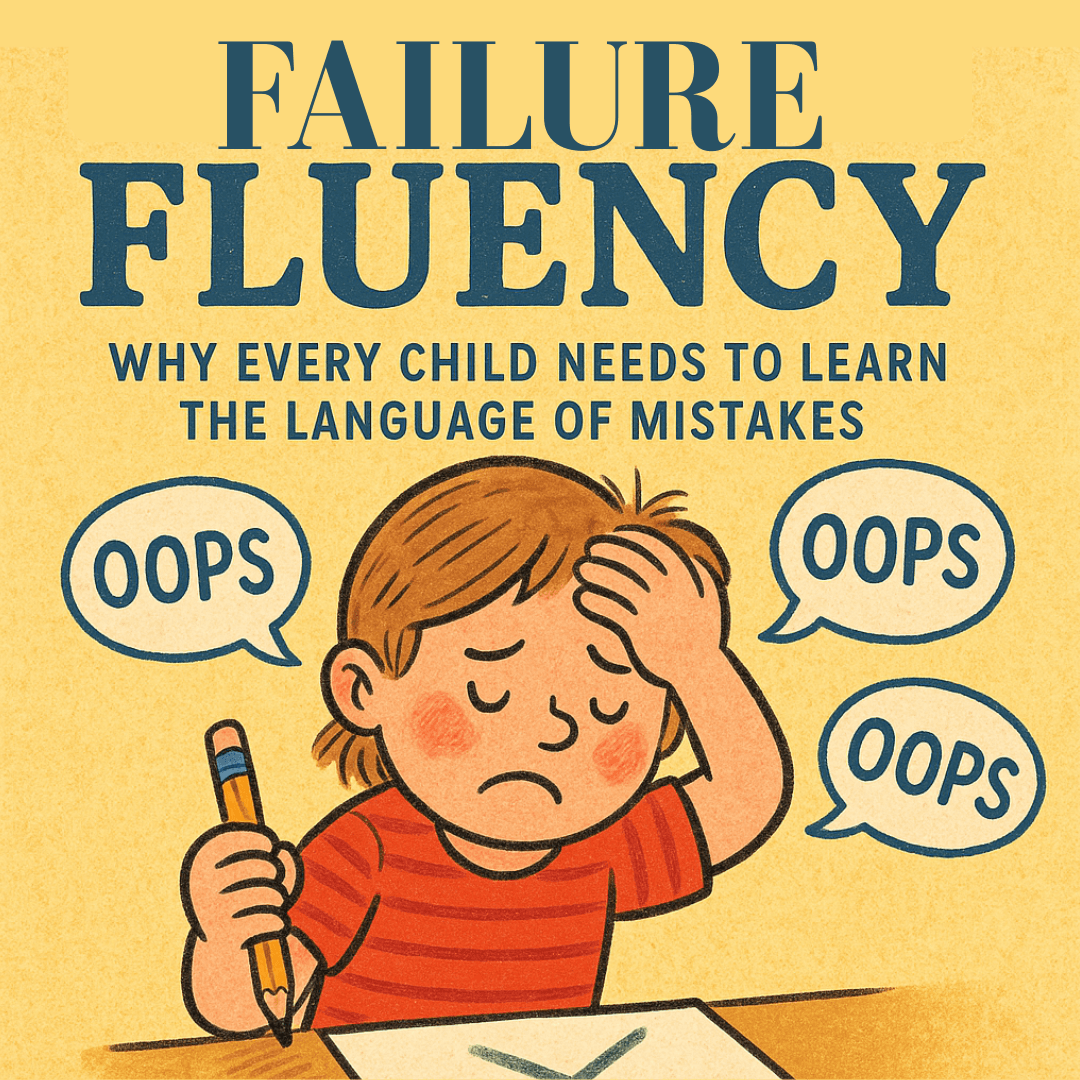
Failure Fluency: Why Every Child Needs to Learn the Language of Mistakes
 Lean Hyphen

Every Great Story Begins with a Setback.
Thomas Edison once said:
“I have not failed. I’ve just found 10,000 ways that won’t work.”
His persistence gave the world the light bulb. Oprah Winfrey was fired from her first TV job and told she was “unfit for television.” Today, she’s one of the most influential women in media. J.K. Rowling was rejected by 12 publishers before her Harry Potter series shaped modern literature.
What do these stories have in common? Each success was born out of setbacks.
The School vs. Life Gap
Schools have always aimed to prepare children for success, and for generations, accuracy and achievement were seen as the clearest signs of learning. But as the world evolves, so does our understanding of what success requires.
A Stanford study by Carol Dweck found that when students believe they can get smarter with effort, they see mistakes as chances to learn. Failure isn’t the opposite of success- it’s the practice that leads to it.
Why Failure Fluency is a 21st Century Skill
The world our children are stepping into doesn’t reward perfection- it rewards persistence, curiosity, and the courage to try again. Employers and innovators alike value those who can face uncertainty, take risks, and grow through setbacks. That’s exactly what failure fluency teaches.
When students learn to look at mistakes differently, something powerful happens:
- Every wrong turn sharpens their critical thinking.
- Every attempt that falls short pushes them toward creative solutions.
- Every disappointment builds resilience, the quiet strength to get back up.
- Every shared challenge deepens collaboration and empathy.
Failure fluency is not about tolerating mistakes- it’s about using them as raw material for growth. In a century defined by change, this ability is not optional. It’s the very skill that separates those who merely survive from those who truly thrive.
Turning Stumbles into Triumphs
Steve Jobs was once forced out of Apple, the very company he co-founded. Many would have seen that as the end, but he used it as a moment to grow, experiment, and take risks. When he returned, he transformed Apple into one of the world’s most valuable companies- proving that a setback can become the springboard for innovation.
Walt Disney faced rejection too; he was fired from a newspaper for “lacking imagination.” Instead of giving up, he kept creating, kept dreaming, and eventually built a global empire of storytelling and creativity. His journey reminds us that criticism doesn’t define potential- it can ignite it.
Even Michael Jordan, often called the greatest basketball player of all time, missed over 9,000 shots and lost 300 games. But each miss was part of his journey toward mastery. His persistence shows that failure isn’t the
Each of these personalities embodies the language of mistakes- and the fluency to translate setbacks into breakthroughs.
How Schools Can Nurture Failure Fluency
Cultivating failure fluency doesn’t mean lowering standards—it means helping students see mistakes as part of the learning journey. Educators can create environments where curiosity and reflection are as valued as correctness:
- Highlight learning from mistakes: Encourage students to share what didn’t work and what they discovered in the process. Celebrating these moments shifts the focus from being “right” to being thoughtful.
- Reflective practices: Journals, portfolios, or short reflections can help students pause, analyze, and internalize lessons from setbacks.
- Peer support and collaboration: When students discuss challenges together and offer constructive feedback, they develop empathy, communication, and teamwork- skills essential for life beyond the classroom.
By integrating these practices, schools can equip students not only with knowledge but with the mindset to navigate uncertainty, take risks, and innovate confidently.
Let’s thrive together
Success in the 21st century isn’t just about what students know- it’s about how they respond when things don’t go as planned. Those who can approach setbacks with curiosity, resilience, and reflection will be the ones who lead, create, and adapt in a rapidly changing world.
The question we should ask students isn’t merely: “Did you get it right?”
It’s: “What did you learn when it didn’t go as expected?”
Because the true language of growth, creativity, and leadership is spoken fluently only by those who have learned to embrace- and learn from- their mistakes.